Friction Lab 2
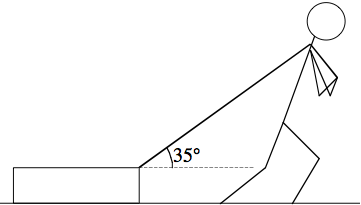
Suppose that I am dragging something along the ground with a rope. This is a very common situation that you will encounter often in your life. What length of rope will make this easiest for me?
Obviously, the key idea here is that you are fighting friction, and you want to oppose friction as effectively as possible. At a first glance, you might think that pulling directly horizontal, so that all your force goes into opposing friction, would be the easiest way, and that the hardest thing to do would be to pull straight up, so that you lift the object off the ground instead of sliding at all. But there is more to it than that, because when the rope is at an angle, the  component of your tension force takes some of the weight off the ground and thus actually reduces the friction force.
This lab will answer this question for you. It will also give you a chance to review what you know about friction: that the force of friction depends on the normal force (how much the two surfaces are pushed together) and also on the coefficient of friction μ (how sticky the surfaces are).
For this lab, you will need:- A wood block.
- A bean bag.
- Two weights.
- A 10 N spring scale.
- A protractor.
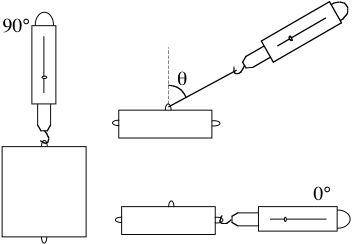
We will be measuring the force required to start the block moving, at different angles, where the angle θ is measured from vertical, as shown in the picture to the right. Then, in order to figure out where pulling is easiest, we will plot these points on a graph. Graphs make it much easier to spot trends in data. In this case, what we want to spot is at what angle the pulling force becomes least.- Add to the block some combination of weights and bean bags in such a way that the weight is about 6-8 N. What is the weight?
- Set the block down on its felt side with the weights you chose stacked on top of it, and try pulling it horizontally, the angle we are calling 90°. How much force does it take to get it moving?
- What is the coefficient of friction of your block? And is that μs or μk?
- In the table below, fill in the force required to move the block at various angles of the string. You already know what the force is for pulling straight up (0°) and pulling straight horizontally (90°) because you found these on the previous page.
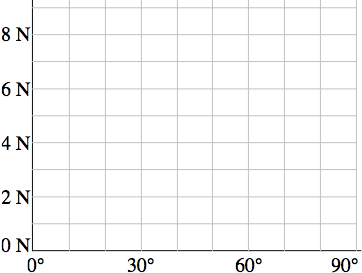
Then, plot the points representing those (angle, force) pairs on the graph to the right. If we are correct that the easiest angle to pull at is somewhere in the middle, the graph should show have a "valley" shape, and you are looking for where the bottom of that valley will be.
| Angle | Force |
|---|
| 0° (up) | |
| 90° (right) | |
| | |
| | |
| | |
| | |
| | |
| | |
- What angle seems to be the easiest to pull at? If you want, you can try a few more angles closer to that one and fill them in on the graph and in the table, to give you a better idea of what the optimum angle is.
- Below, draw a force diagram for the object when the string is at that optimum angle, and fill in the vector form of all the forces.